Composite Materials Guide for Modern Construction
Modern construction is constantly evolving. Builders, architects, engineers, and developers are looking for materials that are stronger, lighter, more durable, and easier to maintain. Traditional materials such as timber, steel, concrete, and aluminium continue to play an important role, but they are now often combined with newer technologies to achieve better performance.
This is where composite materials have become increasingly valuable.
Composite materials are created by combining two or more different materials to produce a final product with improved characteristics. The resulting material may offer greater strength, lower weight, better moisture resistance, improved thermal performance, or a longer service life than the individual materials could provide on their own.
Today, composite materials are used in residential buildings, commercial developments, bridges, infrastructure, cladding systems, structural components, doors, decking, insulation, and many other construction applications.
This guide explains what composite materials are, how they are made, the most common types used in construction, their main benefits and limitations, and what project teams should consider before selecting them.
What Are Composite Materials?
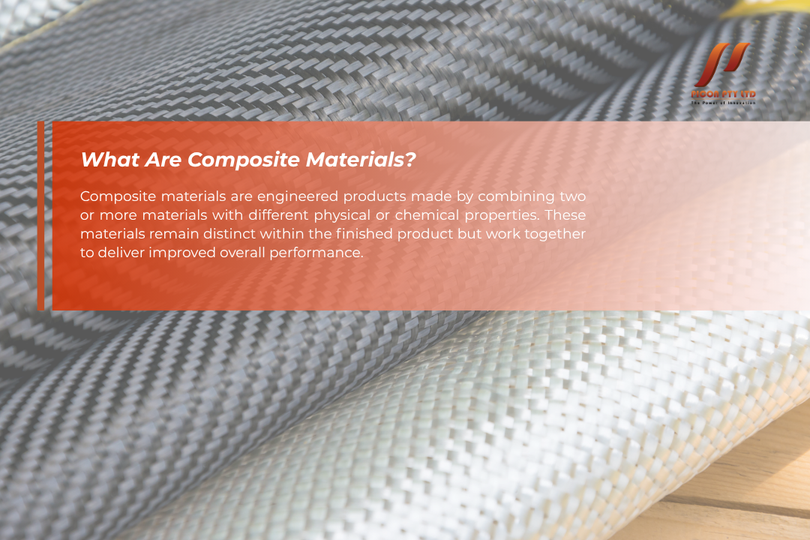
Composite materials are engineered products made by combining two or more materials with different physical or chemical properties. These materials remain distinct within the finished product but work together to deliver improved overall performance.
Most composites contain two main parts: a reinforcing material and a supporting material known as the matrix.
The reinforcement provides strength, stiffness, or stability. It may consist of fibres, particles, layers, or another structural material. The matrix surrounds and holds the reinforcement in place, protects it from damage, and helps distribute loads across the finished product.
For example, fibreglass combines strong glass fibres with a polymer resin. The fibres provide strength, while the resin holds them together and protects them from moisture and environmental exposure.
Reinforced concrete is another familiar example. Concrete performs well under compression, while steel reinforcement improves its ability to resist tension. Together, they create a material suitable for structural slabs, beams, columns, and foundations.
Because manufacturers can adjust the materials, proportions, shapes, and production methods, composites can be designed for specific construction requirements.
Why Composite Materials Are Important in Modern Construction
The construction industry faces growing pressure to improve efficiency, durability, sustainability, and design flexibility. Composite materials help meet these demands by offering properties that may be difficult to achieve with a single traditional material.
Many composites provide a high strength-to-weight ratio. This means they can deliver considerable strength without adding excessive weight to a building. Lighter components are often easier to transport, lift, handle, and install, which may reduce labour requirements and place less load on the supporting structure.
Composite materials can also be designed to resist moisture, chemicals, corrosion, pests, ultraviolet exposure, and changing weather conditions. These characteristics make them valuable for coastal buildings, outdoor structures, industrial environments, wet areas, and projects where maintenance access is limited.
From an architectural perspective, composites can be manufactured in many colours, textures, profiles, and shapes. This gives designers greater freedom to create modern forms while still meeting practical performance requirements.
Fibre-Reinforced Polymer Composites
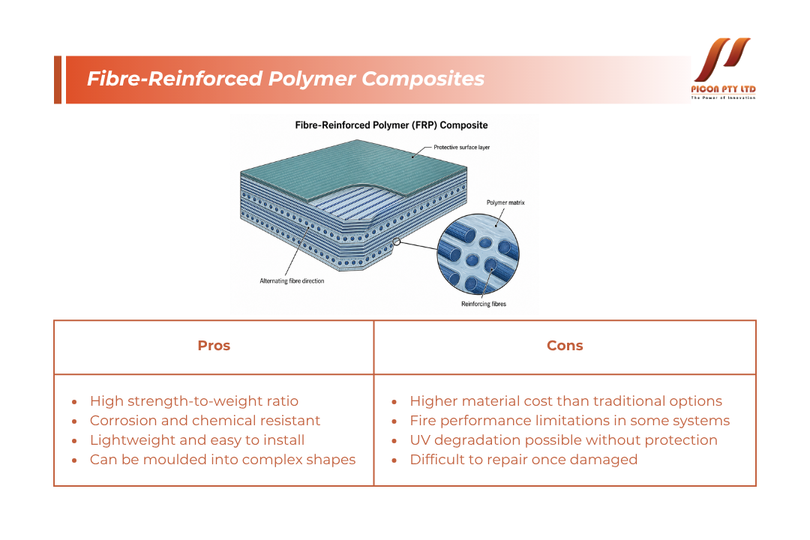
Fibre-reinforced polymers, often shortened to FRP, are among the most widely recognised composite materials used in construction.
These materials combine strong fibres with a polymer resin. Common reinforcing fibres include glass, carbon, and aramid. The resin may be polyester, vinyl ester, epoxy, or another engineered polymer.
Glass fibre-reinforced polymer is commonly used for wall panels, roofing sheets, walkways, handrails, gratings, drainage products, tanks, and architectural features. It is lightweight, corrosion resistant, and relatively easy to manufacture in complex shapes.
Carbon fibre-reinforced polymer offers exceptional strength and stiffness at a low weight. It is commonly used to strengthen existing concrete, masonry, steel, and timber structures. Carbon fibre sheets or strips may be bonded to beams, slabs, columns, or walls to improve load capacity without significantly increasing the size of the structural element.
FRP products are particularly useful in environments where traditional steel components may corrode. However, product selection must consider fire performance, ultraviolet resistance, movement, impact exposure, and compatibility with surrounding materials.
Wood-Plastic Composites
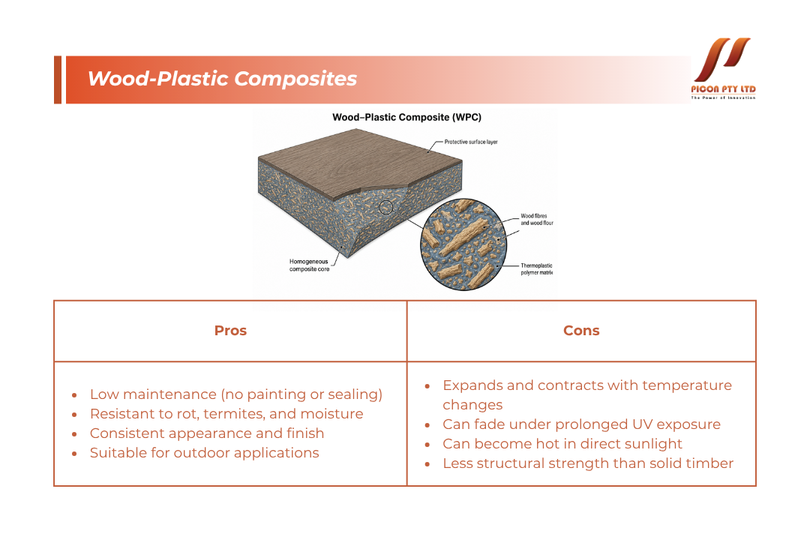
Wood-plastic composites combine wood fibres or wood flour with plastic polymers and additives. They are widely used for decking, fencing, screening, wall cladding, outdoor furniture, and landscaping products.
These materials are designed to provide the appearance and texture of timber while reducing some of the maintenance issues associated with natural wood.
Wood-plastic composite products generally resist rot, termite attack, splintering, and moisture absorption better than untreated timber. They usually do not require regular staining, painting, or sealing, making them attractive for outdoor areas.
Composite decking is especially popular in modern homes because it offers a consistent appearance and is available in many colours and surface finishes.
However, wood-plastic composites can expand and contract as temperatures change. Correct spacing, fastening, ventilation, and installation methods are therefore important. Some products may also become hot in direct sunlight or fade gradually depending on their colour, composition, and level of ultraviolet protection.
Fibre Cement Products
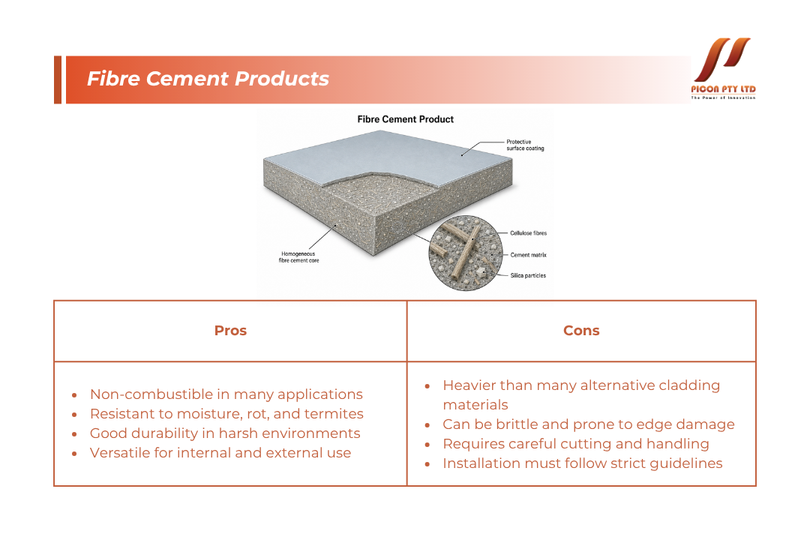
Fibre cement is a construction composite made from cement, cellulose fibres, sand, water, and selected additives. It is commonly manufactured as sheets, boards, planks, panels, soffits, and external cladding products.
The cement provides strength and weather resistance, while the fibres improve stability and help control cracking.
Fibre cement is widely used in Australian residential and commercial construction because it performs well in external and internal applications. It can be used for façades, feature walls, wet-area linings, eaves, floors, and fire-resistant wall systems.
One of the key advantages of fibre cement is its resistance to moisture, termites, and rot. It is also non-combustible in many product configurations, making it useful for projects with demanding fire-performance requirements.
Fibre cement can be painted or supplied with factory-applied textures and finishes. However, it is heavier than many lightweight panel products and must be handled, cut, fixed, and supported according to manufacturer instructions.
Engineered Timber Composites
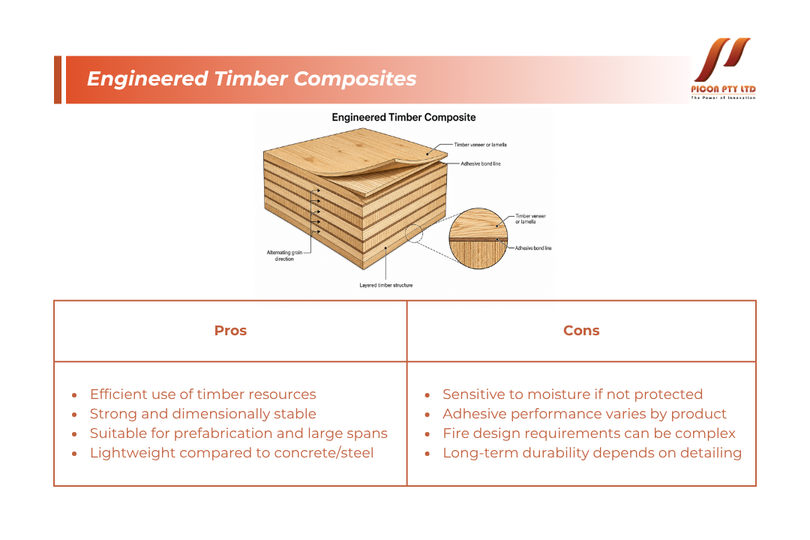
Engineered timber products are created by bonding timber veneers, strands, fibres, or smaller sections of wood together with adhesives. These products use natural timber resources more efficiently while offering more consistent performance than some traditional solid timber components.
Common examples include plywood, laminated veneer lumber, glued laminated timber, oriented strand board, particleboard, medium-density fibreboard, and cross-laminated timber.
Plywood consists of thin timber veneers bonded in alternating directions. This layered construction improves strength and dimensional stability.
Laminated veneer lumber is manufactured from multiple timber veneers bonded together with the grain running mainly in the same direction. It is commonly used for beams, lintels, floor members, and structural framing.
Cross-laminated timber is made by bonding layers of solid timber at right angles to each other. It can be produced as large structural wall, floor, and roof panels for prefabricated and multi-storey construction.
Engineered timber composites offer design flexibility, precision, and efficient use of timber. However, moisture exposure, adhesive quality, fire design, protective detailing, and long-term maintenance must be considered carefully.
Reinforced Concrete
Reinforced concrete is one of the oldest and most important composite materials in modern construction.
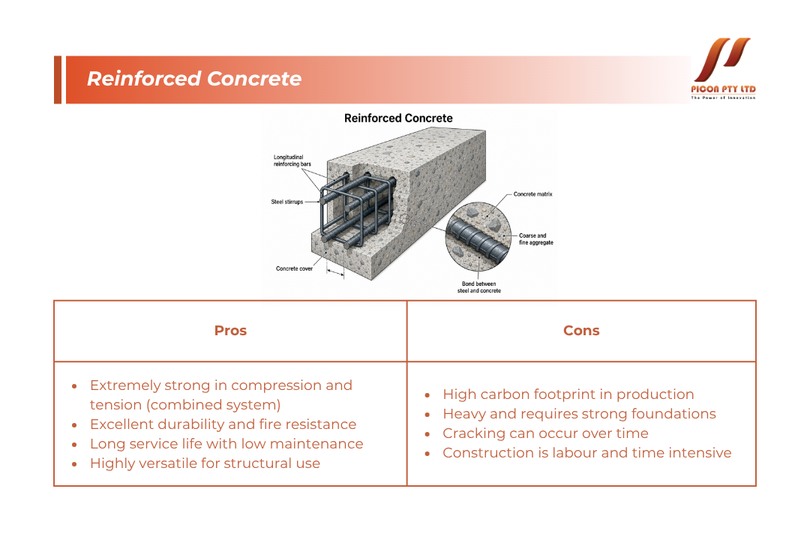
Concrete is extremely strong under compression but relatively weak under tension. Steel reinforcement is added to improve tensile strength and help control cracking.
This combination allows reinforced concrete to be used in foundations, walls, suspended slabs, beams, columns, bridges, retaining structures, and high-rise buildings.
The concrete protects the reinforcement from direct environmental exposure, while the steel helps the structural element resist bending and tensile forces.
High-quality design and construction are essential to ensure adequate concrete cover, correct reinforcement placement, proper curing, and protection against moisture and chemical exposure.
Although reinforced concrete is heavy and carbon-intensive to produce, its durability, versatility, fire resistance, and structural strength make it essential to many construction projects.
Aluminium Composite Panels
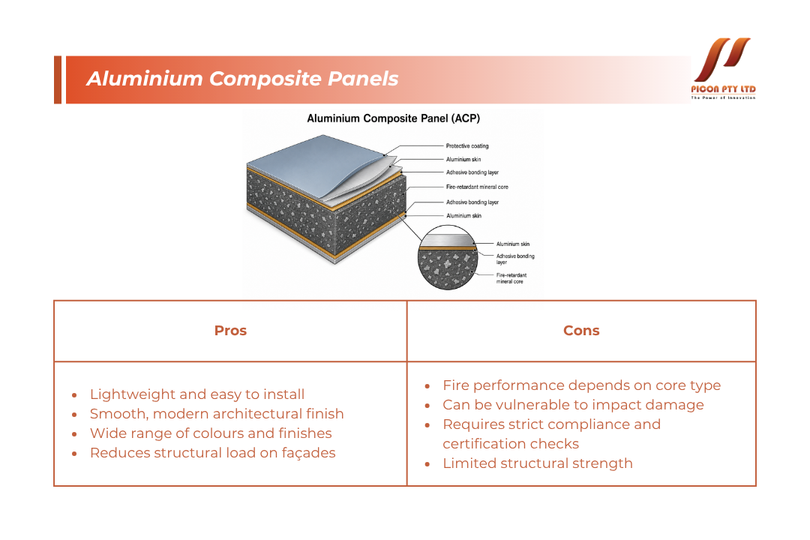
Aluminium composite panels consist of two thin aluminium sheets bonded to a lightweight core. They are commonly used for façades, internal wall linings, signage, canopies, soffits, and architectural features.
These panels are lightweight, smooth, easy to fabricate, and available in a wide range of colours and surface finishes. They can create a clean, contemporary appearance on both new buildings and refurbishment projects.
Their low weight can simplify installation and reduce loads on supporting façade systems.
However, fire performance is a critical consideration. Aluminium composite panels are available with different core materials, and their suitability depends on building type, location, fire requirements, and local regulations.
Project teams should verify product certification, core composition, system testing, installation details, and regulatory compliance before selection.
Composite Insulated Panels
Composite insulated panels are manufactured by bonding strong external skins to an insulating core. The outer skins may be steel, aluminium, fibre cement, or another durable facing material. The core may use rigid foam, mineral wool, or another insulation product.
These panels can provide structure, insulation, weather protection, and a finished surface within one integrated component.
They are commonly used for walls, roofs, cold-storage buildings, warehouses, industrial facilities, modular construction, and prefabricated homes.
Because the panels are factory-manufactured, they can support fast installation and consistent quality. Their integrated design can also reduce the number of separate materials and construction stages required on site.
The final performance depends on the panel core, joint design, fire classification, air sealing, moisture management, and installation quality.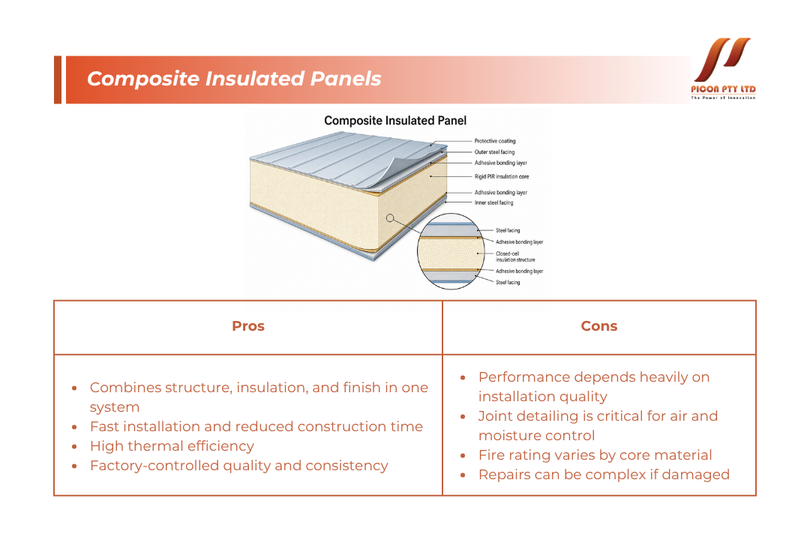
Benefits of Composite Materials
One of the main benefits of composite materials is that they can be engineered around the specific needs of a project.
A composite may be designed to provide high strength while remaining lightweight. It may also combine structural performance with insulation, weather resistance, acoustic control, or a finished appearance.
Durability is another important advantage. Many composites resist corrosion, moisture, rot, insects, chemicals, and weathering. This can make them suitable for areas where conventional materials require frequent maintenance or protective coatings.
Composite construction products are often manufactured under controlled factory conditions, which helps improve dimensional accuracy and reduce inconsistency.
Their design flexibility also allows manufacturers to produce curved forms, textured finishes, large panels, hollow profiles, and complex shapes that may be difficult or expensive to create using traditional materials.
In prefabricated construction, composite panels and components can help reduce on-site work, shorten construction programs, and improve material efficiency.
Limitations of Composite Materials
Despite their many advantages, composite materials are not automatically the best solution for every project.
Some composite products have a higher upfront cost than standard construction materials. The total value should therefore be assessed over the full service life, including installation, maintenance, repair, and replacement.
Repair can also be more complicated. Damage to a composite panel or structural component may require specialised materials, approved procedures, or complete replacement rather than a simple local repair.
Different materials within a composite may respond differently to heat, moisture, and structural movement. Poor detailing can lead to delamination, cracking, deformation, or failure at connections.
Fire performance varies significantly between products. A material described as composite may contain combustible or non-combustible components, so the complete tested system must be evaluated rather than relying only on a general product description.
Recycling can also be challenging because the combined materials may be difficult to separate at the end of their service life.
Sustainability and Composite Materials
Composite materials can contribute to sustainable construction, but their environmental performance depends on how they are manufactured, used, maintained, and disposed of.
Some products incorporate recycled timber, plastic, steel, aluminium, or industrial by-products. Others reduce material use by achieving greater strength with less weight.
Long-lasting composite materials can reduce the need for replacement and ongoing maintenance. Lightweight systems may also lower transport requirements and reduce structural material use.
Engineered timber composites can make better use of smaller trees, timber offcuts, and fast-growing resources. Composite insulated panels may improve thermal performance and reduce operational energy consumption.
However, products that combine adhesives, coatings, fibres, and polymers can be difficult to recycle. Manufacturers are increasingly developing take-back programs, recyclable resin systems, and products designed for disassembly.
When assessing sustainability, project teams should consider recycled content, embodied energy, durability, maintenance, local availability, responsible sourcing, and end-of-life options.
Choosing the Right Composite Material
Selecting the right composite material begins with understanding the actual performance requirements of the application.
Structural products must be assessed for strength, stiffness, loading, span, movement, fatigue, and connection design.
External materials need suitable resistance to moisture, ultraviolet exposure, wind, temperature changes, impact, and corrosion.
Internal finishes may need to meet acoustic, fire, hygiene, moisture, and indoor-air-quality requirements.
The surrounding construction materials should also be considered. Connections between composite materials and steel, concrete, timber, or aluminium must accommodate different rates of expansion, movement, and moisture exposure.
It is also important to review technical data, testing, warranties, installation requirements, compliance documentation, and maintenance recommendations.
Choosing a product based only on appearance or initial price may result in higher costs or performance issues later.
Read more: Flooring Materials Guide for Every Budget
Installation and Workmanship
Composite materials often rely heavily on correct installation to achieve their intended performance.
Cut edges, joints, penetrations, fixings, adhesives, sealants, and support systems must all be handled carefully. Incorrect fasteners or spacing may restrict movement, weaken the system, or allow moisture to enter.
Some products require specialised cutting tools, dust controls, protective equipment, or approved adhesives.
Installers should follow the manufacturer’s instructions and avoid substituting components without confirming compatibility.
For façade and roofing products, waterproofing and drainage details are particularly important. A high-performance panel may still fail if water becomes trapped behind it or if joints are not sealed correctly.
Professional installation and clear quality-control procedures help ensure the finished system performs as designed.
Maintenance and Long-Term Performance
Many composite materials are promoted as low-maintenance, but low-maintenance does not mean maintenance-free.
External surfaces should be inspected for fading, impact damage, loose fixings, failed seals, cracking, or water entry.
Composite decking may require routine cleaning to remove dirt, organic growth, and stains. Cladding systems should be checked around joints, windows, doors, and penetrations.
Structural composites used for strengthening should be inspected for separation, impact damage, or changes in the supporting structure.
Following the manufacturer’s maintenance instructions can protect product warranties and extend service life.
The Future of Composite Materials in Construction
Composite technology continues to develop as manufacturers search for stronger, lighter, safer, and more environmentally responsible building products.
Future materials may include bio-based resins, natural fibres, recycled polymers, low-carbon cement composites, smart materials, and components that can monitor their own condition.
Digital manufacturing is also making it easier to create customised composite building elements with less waste.
As modular construction and prefabrication become more common, integrated composite panels are likely to play an even greater role in delivering fast, accurate, and high-performance buildings.
However, successful adoption will continue to depend on transparent testing, responsible product selection, skilled installation, and clear regulatory compliance.
Final Thoughts
Composite materials have become an important part of modern construction because they allow different materials to work together and deliver improved performance.
From reinforced concrete and engineered timber to fibre cement, composite decking, insulated panels, and fibre-reinforced polymers, these products support a wide variety of structural, architectural, and functional applications.
Their main advantages can include strength, low weight, durability, design flexibility, moisture resistance, and reduced maintenance. At the same time, factors such as fire performance, repairability, installation quality, cost, and recyclability must be assessed carefully.
There is no single composite product that suits every building. The best choice depends on the location, intended use, environmental exposure, design requirements, budget, and expected service life.
By working with experienced designers, builders, engineers, and reliable material suppliers, project teams can select composite materials that improve construction efficiency while delivering lasting performance.
Find the Right Construction Materials with Picon
The performance of any construction project depends on selecting materials that suit the design, environment, and long-term requirements of the building.
At Picon, we support residential, commercial, industrial, and prefabricated projects with dependable construction materials and practical product guidance. Whether you are exploring composite panels, engineered products, cladding systems, insulation, steel solutions, or other modern building materials, our team can help you identify suitable options for your project.
Contact Picon to discuss your material requirements and find construction solutions designed for durability, efficiency, and modern building performance.